Introduction
I have written about Europe’s AI sovereignty problem four times now (Green 2026a, 2026b), and every time I land in the same uncomfortable place. The two pillars Europe leans on (the closed US frontier and the open Chinese weights frontier) are both rotting, and the continent I live in still has no pillar of its own.
The snapshot date above the table is the version. It changes when a frontier model lands, the AA index changes version, or a set of weights moves behind an endpoint.
The two pillars
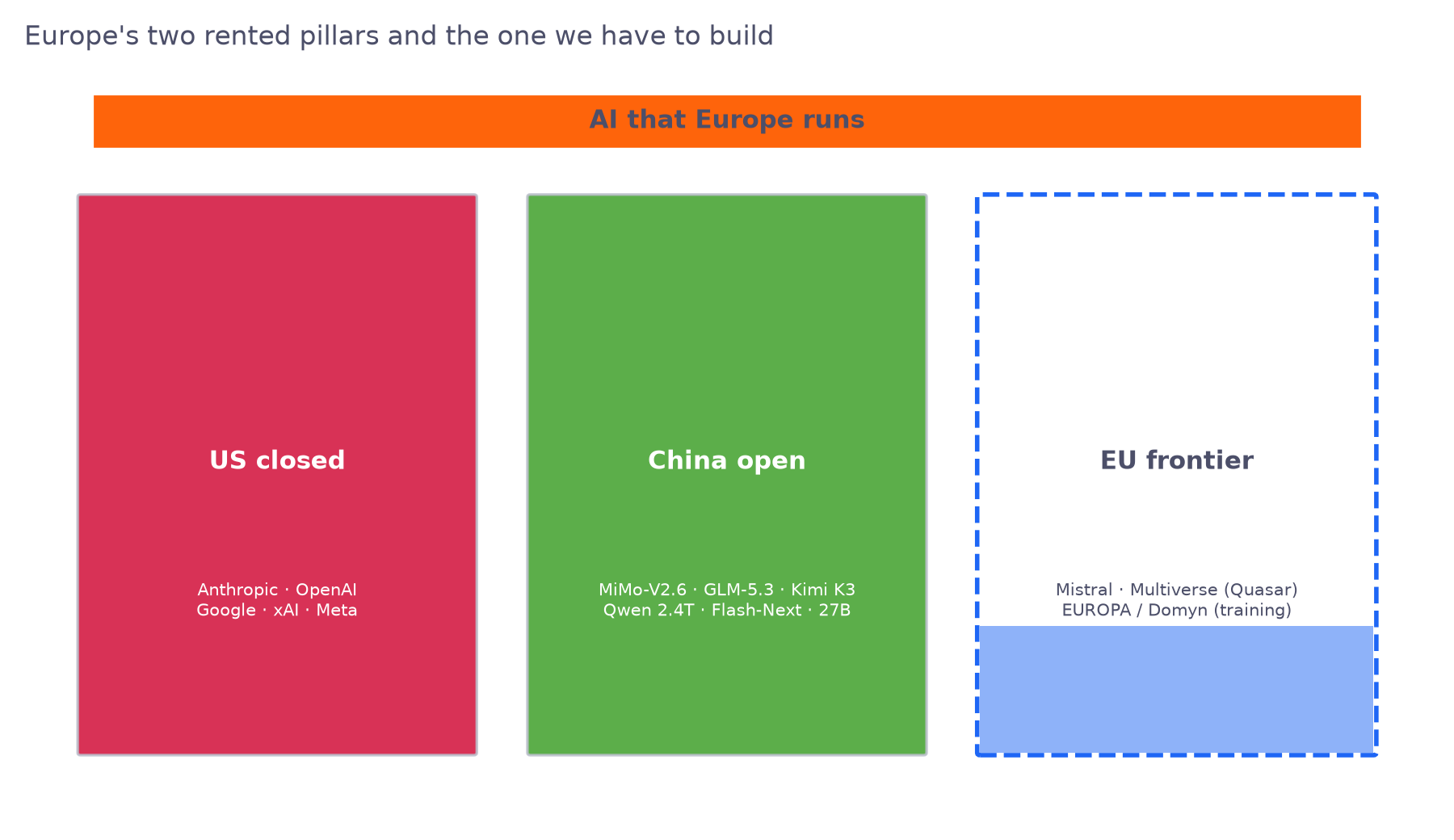
Europe runs its frontier AI on two pillars we do not control. Pillar one is the closed US frontier (Anthropic, OpenAI, Meta, xAI, Google) accessed through APIs whose terms can change overnight based on a government we have nothing to do with. Pillar two is the open Chinese weights frontier (Kimi, Xiaomi’s MiMo, DeepSeek, the Qwen open line, and the GLM line) which ships real weights today but ships them from a jurisdiction consulting on restricting overseas access to its most advanced models (The Next Web 2026). Both pillars can be pulled. We saw pillar two wobble in slow motion when Qwen3.8-Max launched API-only with weights “promised within days”, watched it partly reset on 2026-08-13 when the 2.4T-A95B weights landed on HuggingFace, watched it wobble again when Z.ai shipped GLM-5.3 API-first and delayed the weights over the model’s own cyber capability, and then watched the promise kept in full: the Flash tier landed open on 2026-08-26, and the full 5.3 weights landed on 2026-08-28, two weeks to the day after the API launch, on the schedule Z.ai named up front (Z AI 2026a, 2026b). We saw pillar one’s political risk go from theoretical to concrete when Anthropic tried corporate self-regulation for military use and got punished so publicly that no rational actor will try it again (Anthropic 2026a). Last round the scoreboard grew a European version of exactly that. Spain’s Multiverse Computing now serves a compressed, proprietary copy of GLM-5.2 from its own API, and it is the best European model on the board.
What changed
One model moved the top this round, and the move emptied the frontier window of every lab outside the US.
Anthropic shipped Claude Opus 5.5 on 2026-09-22 (Anthropic 2026b). It grades 57.6 at max effort, 4.2 points above Fable 5.1 and 4.9 above GPT-6 Astra (Artificial Analysis 2026g). That is the largest lead one lab has held over the next on this board; the previous record was 2.2. It is also cheaper than the model it displaced: $4 and $20 per million tokens against Fable 5.1’s $10 and $50, with a 1M-token context at standard rates. The price cut doesn’t show up in AA’s bill (Opus 5.5 is chatty). It spends about 119,000 output tokens per index task against Opus 5’s 73,000, so a max-effort run costs $5.98 a task against $5.86. OpenAI cut prices the same day. GPT-6 Sol, the tier under Astra, costs $2 and $10 per million tokens, half what GPT-5.6 Sol cost, and grades 47.5, 0.1 points short of making this board (TechCrunch 2026). The Opus 5.5 system card calls it the strongest cyber model Anthropic has released (Anthropic 2026c), and the launch post says most cybersecurity tasks get re-routed to Opus 4.8, so Anthropic decides per task what the model will do for you. The EU offer is a watermark for the AI Act and a Bedrock inference profile that keeps data in EU regions (Amazon Web Services 2026). The weights stay with Anthropic, under Anthropic’s terms.
The frontier window is now US-only. With the top at 57.6, a lab needs 47.6 to make the board on merit. Three do, all proprietary: Anthropic, OpenAI (GPT-6 Astra, 52.7) and Meta (Muse Spark 1.3, 48.1). xAI shipped Grok 4.7 on 2026-09-21, also proprietary (SpaceXAI 2026), and at 46.4 it lands 1.2 points under the line (Artificial Analysis 2026e). Every Chinese lab fell out of the window because the top moved 4.2 points in a week.
The open-weights lead changed hands again, and it stayed in China. Xiaomi published MiMo-V2.6-Pro on HuggingFace on 2026-09-21 under MIT: 1.02 trillion total parameters, 42 billion active, a 1M-token context, with text, image, video and audio input (Xiaomi MiMo 2026). It grades 46.3, 1.5 ahead of GLM-5.3 and 0.1 behind Grok 4.7. That makes three open-weights leaders in ten weeks, all Chinese: Kimi K3 in July, GLM-5.3 on 2026-08-28, MiMo on 2026-09-21. The distance from the best open model to the top widened anyway, from 8.5 points last snapshot to 11.3.
A new dated promise joined the board. StepFun’s Step 5 Preview (43.7) is API-only today, a 600B mixture-of-experts with 27B active, with open weights announced for 2026-10-15 and no license published yet (StepFun 2026). It is the Z.ai pattern: ship the API, name a date for the weights. Z.ai kept its date. The Step 5 row gets its verdict on 2026-10-15.
The Qwen Max gap is actually 5.5 points. The last snapshot read the original 0803 endpoint, 0.3 above the open 2.4T sibling. AA added the 0902 API refresh as its own entry on 2026-09-15, after that pull, and it grades 45.4 against 39.9 for the open 2.4T (Artificial Analysis 2026f). The hybrid weights promised “within days” on 2026-08-03 are seven weeks out with no model card (Alibaba 2026b). At the Apsara conference on 2026-09-22 Alibaba previewed Qwen4 as in training, with no dates or prices (Alizila 2026).
The scale held this time. AA shipped v4.3.2 on 2026-09-19, a patch that re-anchors the Elo-based evaluations for stability (Artificial Analysis 2026f). Models that did not change moved by under a point (GPT-6 Astra 52.8 to 52.7, GLM-5.3 44.9 to 44.8, Mistral Medium 3.5 14.9 to 14.2). Unlike the two rebuilds before it, this snapshot is comparable to the last one.
Below the window, little moved. Google’s best is Gemini 3.8 Flash at 40.9 (Artificial Analysis 2026h). DeepSeek’s best is still V4.1-Flash at 39.5. V4.1 Pro has not shipped, and DeepSeek reversed its plan to retire V4 Pro from the API (DeepSeek 2026a). Europe shipped no new model.
The scoreboard
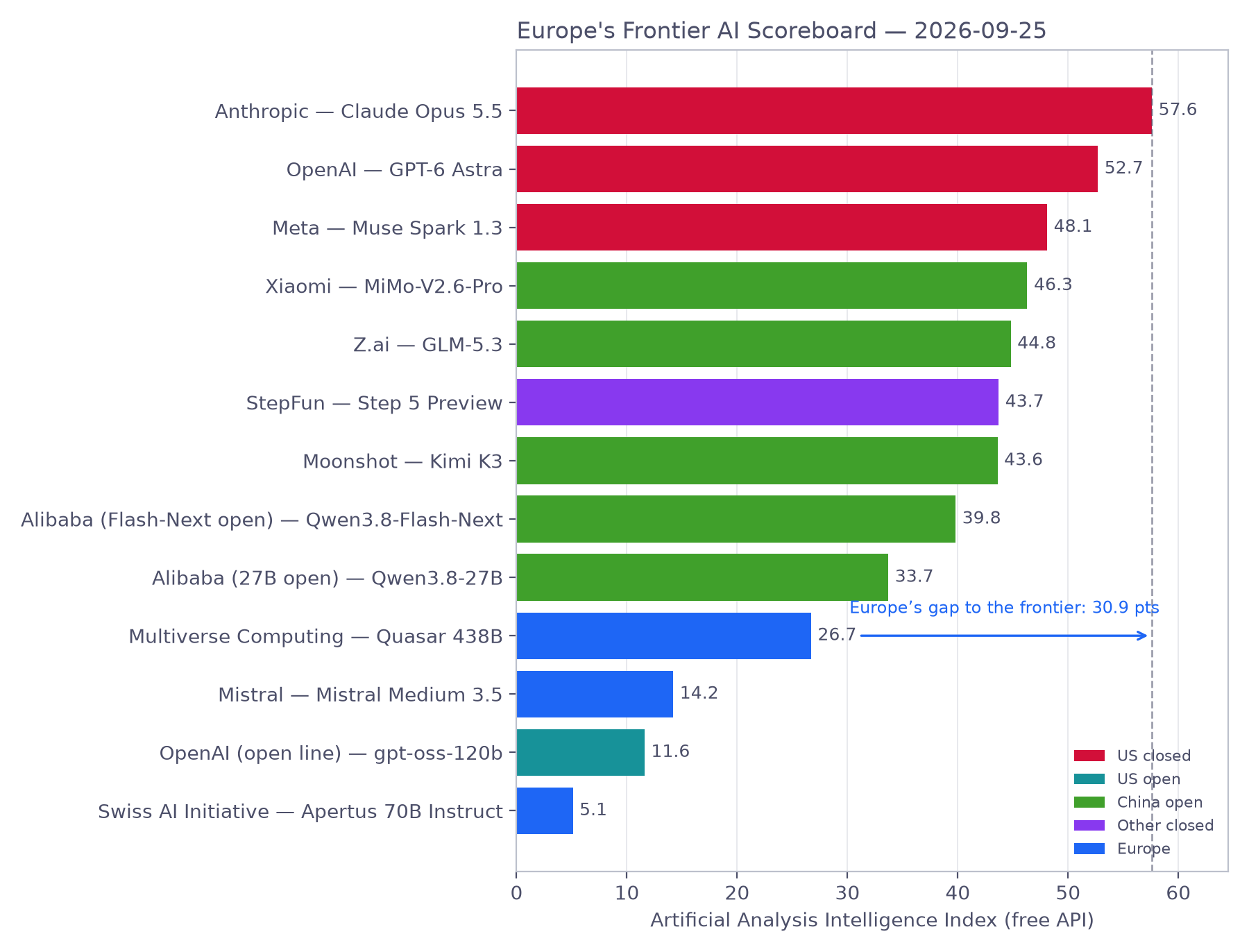
Snapshot date: 2026-09-25. Scores from the Artificial Analysis Intelligence Index v4.3, pulled from their Data API (free tier) (Artificial Analysis 2026d, 2026c). Each row is the top reasoning variant of that lab’s frontier model, selected automatically: a lab enters when its best model is within ten points of the board’s top score, European labs enter regardless of score, and the curated open-line rows carry the open-weights argument. The Δ top column is each row’s distance from the board’s best score. Treat every number as a point-in-time reading. The index was rebuilt twice between 2026-08-28 and 2026-09-15, so scores on this page compare with the 2026-09-15 snapshot (v4.3, patched to v4.3.2 on 2026-09-19) and with nothing before it. The Δ top column and the ordering are the quantities that compare across all of them.
| Rank | Lab | Region | Latest frontier model | Open? | AA index | Δ top | EU access | Verdict |
|---|---|---|---|---|---|---|---|---|
| 1 | Anthropic | US | Claude Opus 5.5 | Proprietary | 57.6 | 0.0 | API | Revocable (ToS and political risk) |
| 2 | OpenAI | US | GPT-6 Astra | Proprietary | 52.7 | −4.9 | API | Revocable |
| 3 | Meta | US | Muse Spark 1.3 | Proprietary | 48.1 | −9.5 | API | Revocable (Meta closed its frontier) |
| 4 | Xiaomi | China | MiMo-V2.6-Pro | Open weights (MIT, shipped 2026-09-21) | 46.3 | −11.3 | Self-host | Revocable (Beijing consulting export limits) |
| 5 | Z.ai | China | GLM-5.3 | Open weights (custom permissive license, shipped 2026-08-28) | 44.8 | −12.8 | Self-host | Revocable (Beijing consulting export limits) |
| 6 | StepFun | China | Step 5 Preview | API-only preview; weights promised for 2026-10-15 | 43.7 | −13.9 | API | Revocable (weights promised, not shipped) |
| 7 | Moonshot | China | Kimi K3 | Open weights | 43.6 | −14.0 | Self-host | Revocable (Beijing consulting export limits) |
| 8 | Alibaba (Flash-Next open) | China | Qwen3.8-Flash-Next | Open weights (Qwen community license) | 39.8 | −17.8 | Self-host | Revocable (Beijing consulting export limits) |
| 9 | Alibaba (27B open) | China | Qwen3.8-27B | Open weights (Apache 2.0) | 33.7 | −23.9 | Self-host | Revocable (Beijing consulting export limits) |
| 10 | Multiverse Computing | EU | Quasar 438B | Proprietary (AA: based on GLM-5.2) | 26.7 | −30.9 | API | EU pillar, under construction, far from frontier (AA: GLM-5.2 derivative) |
| 11 | Mistral | EU | Mistral Medium 3.5 | Open weights | 14.2 | −43.4 | Self-host | EU pillar, under construction, far from frontier |
| 12 | OpenAI (open line) | US | gpt-oss-120b | Open weights | 11.6 | −46.0 | Self-host | Stable, but far from frontier |
| 13 | Swiss AI Initiative | Europe (non-EU) | Apertus 70B Instruct | Open weights | 5.1 | −52.5 | Self-host | European, outside EU jurisdiction |
| n/a | EUROPA / Domyn | EU | In training | TBD | TBD | TBD | EU native | Under construction, >400B params, 24 EU languages |
The MiMo row is the open-weights headline: MIT-licensed, on HuggingFace since 2026-09-21, 46.3, the best open model on the board by 1.5 points (Xiaomi MiMo 2026). GLM-5.3 (44.8) held that lead for under four weeks, Kimi K3 (43.6) for six before it. The Step 5 cell is a date, the way the GLM-5.3 cell was a date in August: API-only until the promised 2026-10-15 weights drop (StepFun 2026). The Qwen family still spans four openness states: a closed Max endpoint (45.4 for the 0902 refresh, below the window and not a row), an open 2.4T sibling (39.9, 5.5 under the closed endpoint), an open Flash-Next architecture preview on the Qwen community license (39.8), and an Apache 2.0 consumer 27B (33.7), with the Max hybrid seven weeks past its launch-day promise (Alibaba 2026b, 2026a). The Multiverse cell is proprietary, based on GLM-5.2, and served from Spain (Artificial Analysis 2026i). OpenAI’s gpt-oss-120b, the only American open-weights row, grades 11.6, which puts it in research-artifact territory.
How to read it
The AA index moves week to week as it re-aggregates. It was rebuilt twice in early September, and this round it only took a patch, v4.3.2 (Artificial Analysis 2026f). Intelligence Index v4.3 aggregates ten evaluations (AA-Briefcase, GDPval-AA v2, AutomationBench-AA, Terminal-Bench v4.0, SciCode, Humanity’s Last Exam, GDP.pdf, CritPt, AA-Omniscience, AA-LCR v1.1), and roughly 40 percent of the composite is now graded on private test sets (Artificial Analysis 2026a, 2026b). A model can gain or lose a point or two without a new release, just because the index re-sampled. It can lose a lot more when the yardstick gets replaced. So a point or two between the rows at the top of the board is noise. The signal is which labs are within shouting distance of the frontier top, and which access regime they ship under. The frontier window now closes after row 3, Muse Spark 1.3 at 48.1. Grok 4.7 (46.4), MiMo-V2.6-Pro (46.3), Qwen3.8-Max-0902 (45.4), Google (40.9) and DeepSeek (39.5) all sit below it.
“Open?” is the column that matters most for Europe, and it is the one most likely to lie to you. The MiMo cell is a receipt: MIT weights on HuggingFace the day the model was announced (Xiaomi MiMo 2026). The Step 5 cell is a promise with a date, 2026-10-15, and no license yet (StepFun 2026). The GLM-5.3 cell shows what a kept promise looks like: the Flash sibling open under MIT since 2026-08-26, and the full 5.3 weights on HuggingFace on 2026-08-28, on the two-week schedule Z.ai announced up front (Z AI 2026a, 2026b). The Qwen cell is still a promise: the Max hybrid was promised “within days” on 2026-08-03, and seven weeks later the model card is still not on HuggingFace, while everything below the Max line (2.4T, Flash-Next, 27B) is open and a dated API refresh shipped instead (Alibaba 2026b). Alibaba fenced its Max tier across two generations (Qwen3.7-Max proprietary, Qwen3.8-Max paid preview), and the 2026-08-13 open-weighting of the 2.4T-A95B broke the pattern for everything except the top. The 27B cell is the one with no promise and no asterisk. Apache 2.0, on HuggingFace, downloadable today.
“EU access” comes in two kinds. API access means you can call the model today and you cannot run it yourself tomorrow if the provider decides you should not. Self-host means you have the weights on hardware you control, and the only thing that can take that away is a license change you can see coming or a jurisdiction deciding to restrict exports.
Where Europe sits
None of the European labs shipped a new model this round. Multiverse Computing is still the best-graded of them. Quasar 438B (26.7, ranked #124 among all graded variants) is proprietary, served from Multiverse’s own CompactifAI API, and, by Multiverse’s own technical note, “a compressed model built from GLM-5.2”, the Chinese open-weights model, pruned with their quantum-inspired method (Multiverse Computing 2026; Artificial Analysis 2026i). At launch Multiverse billed it as Europe’s leading AI model. That is technically true, and it is the wrong lesson. On the index AA was running at launch, the open GLM-5.2 original beat the compressed copy 53 to 43. On today’s v4.3 it still leads 33.7 to 26.7, 7.0 points, and the original is free to self-host while the copy is API-only. Their previous graded model, HyperNova 60B, is the same pattern: AA labels it “based on gpt-oss-120b”, the American open-weights artifact. Both of Multiverse’s graded rows are compressions of other labs’ open models. That is a real business, and it is a long way from a frontier.
Mistral is still the closest thing Europe has to a frontier lab, and the ASML-led 1.7 billion euro Series C put real compute behind that (CNBC 2025). It is now the second-best European lab on this board. Mistral Medium 3.5 grades 14.2 on v4.3, ranked #285, 43.4 points off the top, and nothing Mistral has shipped since April grades above it. The frontier-tier question (does Mistral ship a model that sits in the top three of the AA index, ever) is still open. Mistral is the European pillar under construction, and “under construction” is still the generous reading.
The EUROPA consortium led by Domyn is the other one to watch, and it is unchanged. The EU Frontier AI Grand Challenge is funding a >400 billion parameter model trained on all 24 EU languages on a 6,000-chip Nvidia Blackwell cluster (European Commission 2026). It is still the only announced European project that names the frontier tier as the goal instead of using it as a slogan. It is also not a frontier model yet, and the gap between “we are training a 400B model” and “we have a model in the top three of the AA index” is exactly the gap Europe has been failing to close for two years.
Apertus 70B (Swiss AI Initiative, 5.1, ranked #636) is real, downloadable, European, and 52.5 points off the frontier. Europe’s third-best graded lab is not close to Europe’s best, and Europe’s best is a compressed copy of somebody else’s model.
There is still no European row in the top half of the table. The best European variant sits 30.9 points off the top, up from 26.3 last snapshot, ranked #124 once every graded variant is counted. All 4.6 points of the widening came from the top moving.
What would change the table
These would move the table beyond normal score drift:
- StepFun ships the Step 5 weights on 2026-10-15. The row flips from a date to a receipt, or it joins Qwen Max as a promise gone quiet (StepFun 2026).
- DeepSeek V4.1 Pro ships. DeepSeek’s best graded model is still V4.1-Flash, open weights under MIT, shipped 2026-09-10, at 39.5 (DeepSeek 2026b). V4.1 Pro has not shipped, and V4 Pro stays on the API for now (DeepSeek 2026a). If V4.1 Pro lands anywhere near the window, DeepSeek is back.
- Qwen3.8-Max hybrid weights actually ship. Seven weeks and one dated API refresh later, still no model card, and the refresh now grades 5.5 points above the open 2.4T. Z.ai has now kept a dated weights promise; Alibaba’s is the standing counterexample. I will believe the hybrid when the model card lands on HuggingFace.
- Qwen4 ships. Alibaba previewed it as in training at Apsara on 2026-09-22, with no dates (Alizila 2026). Flash-Next is still the only open preview of the Qwen4 architecture. If Qwen4 lands as a Max-class open drop, the top of the board is in play. If it lands API-only with open siblings below, the Qwen pattern repeats at the next generation.
- Beijing formalizes the overseas-access restrictions it has been consulting on. The reporting now says the Ministry of Commerce is drafting a tiered export regime that would treat Qwen and DeepSeek weights the way Washington treats advanced chips (The Next Web 2026). Several Chinese rows flip their verdict from “Revocable” to “Restricted” and pillar two gets measurably weaker for Europe.
- A US provider changes terms in a way that breaks EU access (region lock, use-case restriction, government-mandated cutoff). The corresponding US row gets a date stamped on its verdict.
- Google ships something that re-enters the frontier window, or Mistral or EUROPA publishes a model that lands in the AA index top ten. A row leaves or joins the board.
- Meta re-opens a frontier-tier Muse Spark with open weights, or OpenAI ships an open-weights model above 40. The US regains an open-weights frontier leg, and the two-pillar story gets a third leg I did not expect.
- A non-US lab re-enters the frontier window. Right now the window holds three American closed labs and nothing else. Grok 4.7 and MiMo-V2.6-Pro sit 1.2 and 1.3 points under the line; either would change that with one release.
Conclusion
Every time a frontier model lands, the good news is about someone else’s model and the bad news is about someone else’s decision. Europe’s role is to read the announcement and adjust its compliance documentation.
Ten of the thirteen scored rows are non-European. The European rows start 30.9 points below the frontier and fall away from there. Every row above them is a model Europe uses on terms set outside Europe. The frontier window itself is now three American closed models, led by Claude Opus 5.5 by the widest margin this board has recorded. The good news in the structure is that the open-weights frontier keeps moving: MiMo-V2.6-Pro, MIT-licensed, 46.3, the third open leader in ten weeks. The bad news attached to it is that all three leaders are Chinese, the open frontier sits 11.3 points under the closed top instead of 8.5, and the exceptions on the board are a research artifact and a copy: OpenAI’s gpt-oss-120b at 11.6, and Europe’s own best entry, a proprietary compression of a Chinese open model that scores 7.0 points below the original.
Z.ai named a date for the GLM-5.3 weights and kept it. Xiaomi shipped MiMo’s weights with no promise at all. StepFun named 2026-10-15. Alibaba put a new date on a closed API and let the hybrid promise run past seven weeks, while the closed endpoint pulled 5.5 points ahead of the open one. Each of those weights ships when the lab that trained it decides, and Europe has no say in any of the dates. The closed US frontier got a new leader this round, cheaper per token and stronger than anything before it, and it is revocable, as we watched the political risk go concrete in March. The European pillar is under construction, and the best European model on the board is a compressed copy of a Chinese open model, served from a Spanish API. Of the three pillars, it is the only one Europe controls.